
How I Host Mothership
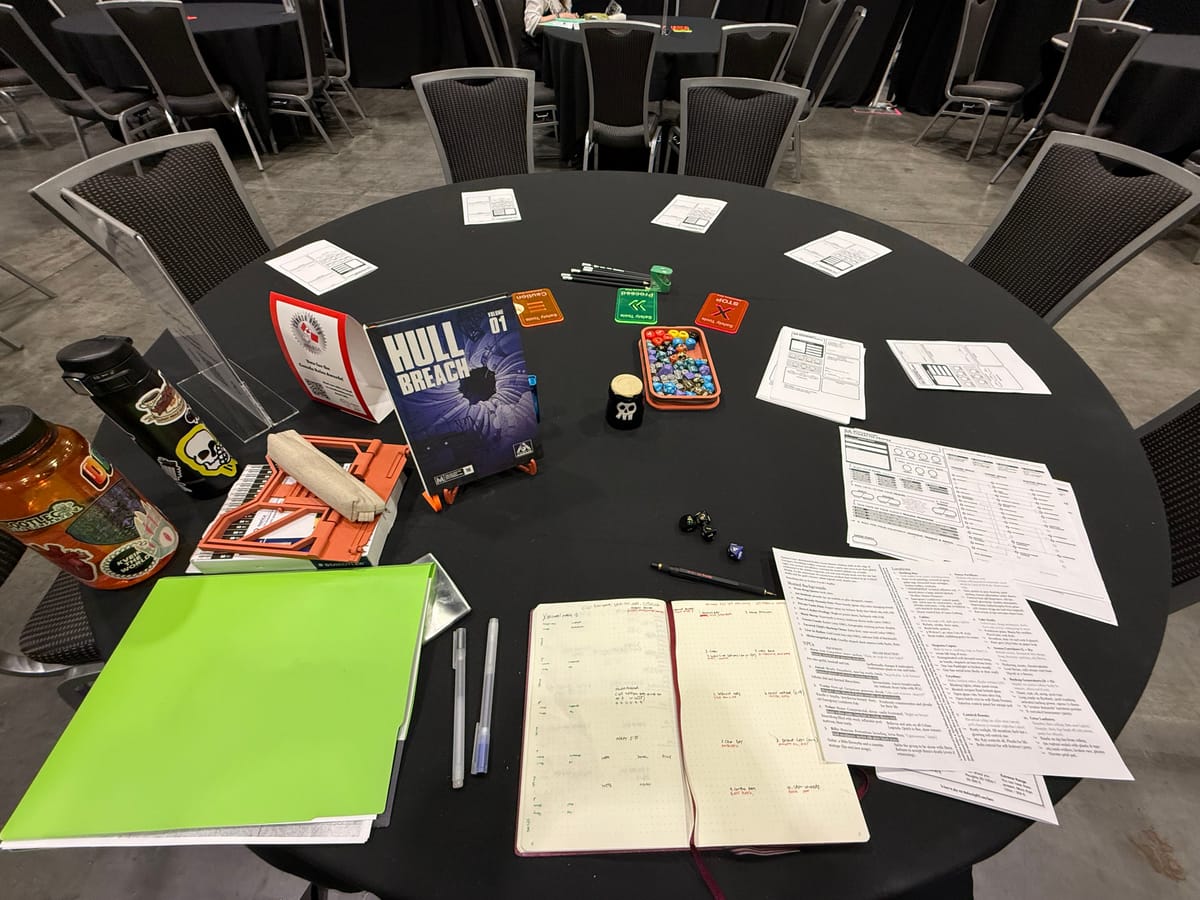
Over the course of hosting Mothership from the work-in-progress version through to the finalized 1e, I’ve refined the way I host it. Here are ten points on what I focus on with games at my table. Some of it’s more philosophy than concrete procedures, but these are the things I keep in mind along with the direction of the session itself. I’m sharing them with the aim of helping you refine your process, so more of the session is spent role-playing and less on everything else.
01. Collaborative by default. Everyone at the table tells the story of the survivors of this experience, together. None of us know who the survivors are yet, we’ll figure it out as we go. It’s one reason why I’m trying to stop saying that I “run” Mothership, but instead host or facilitate; we’re all running it. I’m as excited as everyone else to find out what will happen. I want to see the characters succeed against the odds. This is more of a framing effort than a major shift in play at the table, but I find it helps erase adversarial GMing, and make the game more player-led. It also helps me stop re-narrating what’s already been described.
02. Define things just-in-time. In keeping with the anti-canonical nature of Mothership, the lore across sessions is the set of truths we decide during play. To limit how much there is to remember, we can define it only when needed. It’s also how I handle “the rule of cool”—we celebrate when players add a meaningful truth that extends and respects existing truths. It’s the perfect “yes, and” to extend the story. My players once decided to attach a vibechete to a length of pipe for more reach, and it meant that story arc’s vibechetes always had a trigger on the handle that could be taped or held down. Now a dropped vibechete is a rattling danger!
03. Real-time clock. Beyond preventing stall, this helps me maintain the pacing and timing of events, stops overlong player discussion and planning, and keeps the game cinematic. Time skips and slowdowns are appropriate when it matters, but I don’t stop the clock when players discuss their next steps at length while the horror lurks around the corner. I love when modules have procedures to follow on timers. Vibechete! has ticking ambush scores and NPC murders; Brackish tracks constant flooding; Bloom tracks infection stages. I especially love rolling on random tables with increasing modifiers.
04. Always describe Stress. What’s your crewmember doing, what led to the stress? Failing the Check while breaking into a terminal could mean answering why crew skilled in Computers and Hacking get stressed out. I never just say “take 1 Stress,” instead they’ve raised a silent alarm, or realized security systems caught up during their time in cryo. This is a great spot for some in-character role-play to bring the Stress into the story, which leads into my next point.
05. Failed rolls are not always failed actions. Failed Checks and Saves are the opportunity to twist the action into something far more interesting. Beyond just making things get worse, the action might succeed, but the monkey’s paw curls or there’s a horrible realization. This is also a moment for players to narrate how the Stress affects their crew, too. One day I hope to see players cheer at Critical Failures as much as Critical Successes and become sickos just like me.
06. Violent Encounters also fail forward. It turns out I prefer Warden-facing rolls; I feel like this reliably honours NPC statblocks, and telegraphing moves mirrors how players declare actions. This just means I’m rolling Combat and Instinct Checks just like contractors. A horror’s failure on a Check is a lot like the above point for the player crew: things get worse and the horror doesn’t reliably accomplish the stated goal. Rather than following through on the telegraphed slashing of the crewmember in front of them, the Gaunt rips open the nearby bulkhead, breaking a pipe and filling the corridor with steam. I don’t describe the action as failure, I just describe what’s happening. I’m working towards building this into how players also resolve failed rolls, aiming to partner up with them when describing how the end result happens.
07. Violent Encounters end in three rounds or less. This helps prevent “D&D brain” gladiatorial combat of trading blows back and forth, helps keep all players engaged, and maintains the “violent” in violent encounters. Perhaps by the end of three rounds the crew is separated, fleeing becomes the only good option, or the horrors change tactics and retreat even if they haven’t suffered a Wound. It just can’t drag on beyond three rounds, something must change to dramatically alter the situation.
08. It’s supposed to be challenging. I have found it actually pretty hard to make encounters too dangerous. That’s especially true when following the suggestions and procedures around telegraphing danger and NPC actions found in the Warden’s Operation Manual. Good modules get this right, too, with creative opportunities to show off the danger. It is, after all, survive, solve, or save.
09. Use the wishlists. My goal is that each player sees a straight-up benefit or gimme based on their crewmember’s class or skill list. “This looks as poisonous as anything in your botany textbooks,” “any marine can tell this gun hasn’t been maintained,” or “mechanical repair instincts reveal a recessed access panel.” My aim here is helping players see where they can cleverly leverage the class and skills they’ve picked, and see problems the way they imagine their crew would.
10. Just like every group project ever. When the players decide to commit to a single course of action together, it’s usually because they really want it to succeed. This isn’t a montage of actions where I’d reach for Quadra’s very good Challenge HP, but instead one single round of group dedication. A door they really want securely shut, a scramble for the only weapon before it’s back in enemy hands, or tethered together jump onto a vessel in zero-g. I’ve settled on barely filing the serial numbers off Group Actions from Blades in the Dark. One crewmember leads the group action, and everyone participating rolls appropriate Checks. Any successful Check counts as success for all, but the leader takes all Stress from failures. Critical Failures negate successes 1:1, and only result in a Panic Check if all successes are cancelled out. Just like the Stress, the leader makes the Panic Check.